Memory isn’t supposed to defend itself. At least, not in classical computing. Once a secret is stored in RAM, it can be read, cloned, and exfiltrated without a trace. Cold boot attacks, DMA injection, and memory scraping tools have made this vulnerability painfully real—especially in the era of post-quantum threats.
But what if memory acted more like a quantum system?
CollapseRAM™ is a symbolic memory architecture I’ve developed that brings quantum-inspired behavior to classical hardware. Instead of just bits, CollapseRAM uses a third register state: ∆, the ambiguous triangle. A register in ∆ mode holds a symbolic value that is intentionally unreadable—until it’s collapsed. The act of reading it irreversibly resolves the value, much like quantum measurement. And if the register is entangled with others, that collapse propagates.
This isn’t theoretical. CollapseRAM™ runs on FPGAs. It simulates the BB84 quantum key distribution protocol entirely in RAM. No photons, no network, no exotic hardware. Just symbolic logic, collapse-on-read memory, and basis-aware entanglement—all implemented in a system compatible with existing software via memory-mapped I/O.
Key Features
∆ registers: Symbolic states that collapse when read
In-memory BB84: QKD performed between memory endpoints
Bit commitment: Symbolic locking and reveal using basis/phase logic
FPGA prototype: Real hardware running symbolic collapse logic
Post-quantum ready: No reliance on traditional crypto primitives
This project is part of a broader framework I call TSPF—the Triangle Symbolic Processing Framework—which explores symbolic entanglement, phase logic, and memory-level protocol design for security and computation.
If you’re a researcher in cryptography, post-quantum security, symbolic AI, or hardware security, I’d love your feedback. Feel free to fork the repo, open issues, or get in touch.
CollapseRAM™ isn’t just a new kind of memory. It’s a shift in how we think about what memory does.
As quantum computing advances and digital threats grow more sophisticated, new approaches to system security are urgently needed. One such approach is the Bullet-Proof Machine — a conceptual computing model that relies not on quantum hardware or conventional cryptography, but on symbolic logic principles that enforce deterministic, secure behavior at the register level.
This model builds upon symbolic collapse primitives, forming a framework where information itself becomes constrained by epistemic rules. At its core is the idea that registers can be intentionally ambiguous, and that accessing them changes their state irrevocably.
Symbolic Collapse Explained
The foundation of this model is the symbolic ambiguity state, represented by the symbol Δ. A register in this state does not contain a fixed bit value. Instead, it holds epistemic uncertainty — a formally undefined bit that must be collapsed before it becomes usable.
This mimics quantum measurement. If the receiver’s basis matches the sender’s, the register resolves deterministically. If it does not, the collapse introduces entropy.
Enforcing No-Cloning on Classical Machines
One of the most important aspects of this model is symbolic no-cloning. Registers in state Δ cannot be duplicated, read twice, or inspected without changing their state. Attempting to copy a Δ register causes immediate collapse, eliminating the ambiguity and yielding a resolved bit value. This means that all attempts to fork, clone, or mirror the register are inherently destructive if performed before legitimate resolution.
In this design, once a register is read, its state is resolved and cannot be restored. There is no possibility of re-reading the original Δ. This constraint introduces strong epistemic integrity to all read operations.
Symbolic State as Security
The Bullet-Proof Machine represents a new way of thinking about computation. Instead of assuming that all memory is readable and duplicable, this model treats symbolic memory as logically constrained. Reading a symbolic register becomes a destructive operation, and duplication becomes either impossible or provably detectable.
Security follows naturally from this model. Observing the state changes it. Forking the state forces entropy. As a result, this framework supports the development of secure protocols such as:
One-time pad-style session key derivation using collapse-only logic
Symbolic boot states that become invalid once inspected
Entanglement-style propagation of collapse through memory chains
Forensic traceability based on irreversible collapse chains
Comparison to Quantum Behavior
While this model is entirely classical, it captures key features of quantum systems:
Irreversibility through collapse
Observer-dependent state resolution
No-cloning enforced symbolically
Basis-sensitive divergence
Unlike quantum systems, it does not require hardware based on quantum entanglement or superposition. Instead, it redefines memory semantics around symbolic ambiguity and deterministic collapse.
A New Paradigm for Secure Machines
The Bullet-Proof Machine is not simply a more secure computer — it is a different kind of machine. One that reasons about information as an epistemic process rather than just a binary value stream.
It offers an alternative to both conventional memory models and emerging quantum architectures by establishing a third path: classical symbolic computation constrained by logical irreversibility.
Conclusion
This approach opens the door to post-quantum secure systems that operate with classical reliability but symbolic integrity.
By redefining the behavior of memory through symbolic collapse, the Bullet-Proof Machine introduces a novel framework for secure state modeling and tamper-evident computation. It cannot be read twice. It cannot be duplicated without consequence. And it is inherently capable of modeling sensitive state transitions, observer effects, and basis-aligned logic — all without quantum hardware.
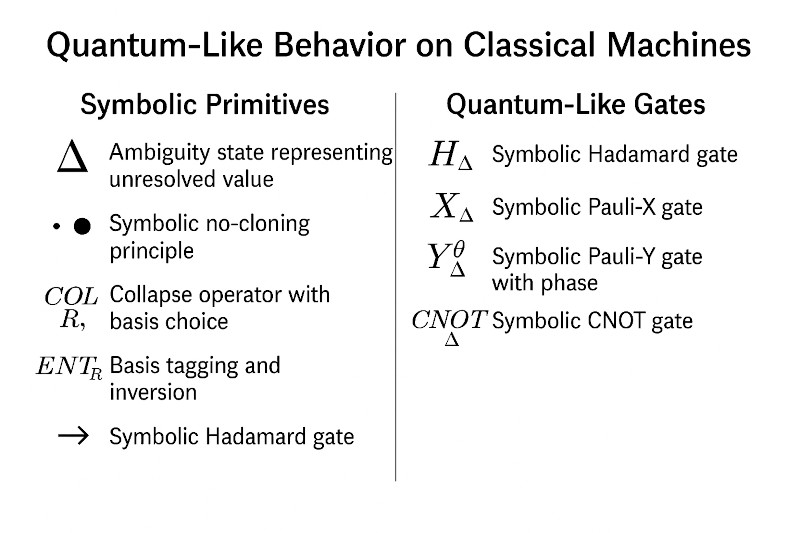
At the core of the Triangle Symbolic Processing Framework (TSPF) lies a family of symbolic primitives that simulate quantum‑like behaviors in classical environments. These primitives do not use quantum hardware, but they offer a deterministic approximation of key quantum phenomena such as ambiguity, collapse, entanglement, basis sensitivity, and symbolic no‑cloning. Together, they form the foundation for a logic architecture that mimics quantum gates using classical symbolic representations.
1. Ambiguity State (Δ)
The ambiguity symbol Δ represents a symbolic register in an unresolved state. It is not a classical 0 or 1, nor a probabilistic superposition, but rather an epistemic uncertainty—a logical symbol that signifies an unresolved bit. Registers in the Δ state cannot be copied or duplicated because their value is undefined. Any attempt to clone or inspect Δ prematurely forces collapse, irreversibly resolving it. This enforces the symbolic no‑cloning principle, mirroring the spirit of the quantum no‑cloning theorem.
2. Collapse Operator
Collapse is defined using the operator COL_Δ(R, B), which takes a symbolic register R (in state Δ) and a basis B (usually X or Z).
If B matches the initialization basis, collapse is deterministic, yielding the correct bit.
If B differs, collapse still resolves Δ but outputs a random bit, injecting symbolic entropy.
Once collapsed, R becomes fixed (0 or 1) and Δ is destroyed. This operation satisfies three key constraints:
Irreversibility
Symbolic no‑cloning
Basis sensitivity
3. Basis Tagging
Each Δ register is initialized with a hidden basis (X or Z). During collapse, only if the chosen basis matches this tag will collapse be coherent. This tagging is essential for BB84-style protocols, ensuring alignment is only determined post-collision.
4. Entanglement Primitive
The primitive ENT(R₁, R₂) symbolically links two Δ registers across agents. Collapsing one leads to the correlated collapse of the other:
If bases match, both parties register the same bit.
If bases mismatch, divergent outcomes occur—simulating Bell‑pair behavior for E91 protocols.
5. Logical Operations
SYM_NOT(R): Inverts a resolved bit. Applied pre‑collapse, it influences collapse logic deterministically.
Derived Quantum‑Like Gates
QSymbolic builds on the core primitives—ambiguity (Δ), collapse (COL_Δ), entanglement (ENT), no‑cloning, phases—to define symbolic counterparts of quantum gates. Although fully classical and deterministic, these gates mirror key conceptual properties of their quantum analogues:
Symbolic Hadamard (H_Δ)
Analogous to the quantum Hadamard gate—which transforms a definite state |0⟩ or |1⟩ into an equal superposition (\|0⟩ + \|1⟩)/√2 —H_Δ takes a resolved bit (0 or 1) and maps it to Δ, assigning a random hidden basis (X or Z). This introduces epistemic ambiguity, enabling basis-dependent collapse behavior.
Symbolic Pauli‑X (X_Δ)
Mirrors the quantum Pauli‑X (bit‑flip) gate, which swaps |0⟩ to |1⟩ . Symbolically, X_Δ inverts a resolved bit (post-collapse). Applied pre-collapse, it flips the expected outcome when matched against the initialization basis, impacting collapse prediction in entangled contexts.
Symbolic Pauli‑Y (Y_Δ)
Inspired by the quantum Pauli‑Y gate—combining bit‑flip and phase‑flip (π rotation around the y-axis) —Y_Δ performs a symbolic bit-flip and appends a phase tag (θ). While bits flip, mismatched basis collapse reveals symbolic “phase displacement,” aiding traceability of collapse errors or adversarial intervention.
Symbolic Pauli‑Z (Z_Δ)
Modeled after the quantum Pauli‑Z (phase‑flip) gate , Z_Δ does not alter bit value but sets a phase tag θ. Under correct basis, it’s inert. With mismatched basis, the phase tag becomes observable, offering a semantic trace of the collapse event and basis misalignment.
Symbolic CNOT (CNOT_Δ)
A proxy for the quantum controlled‑NOT gate: if control register A collapses to 1, SYM_NOT flips target register B. If A→0, B remains unchanged. This conditional symbolic behavior emulates quantum conditional logic and can propagate entanglement or symbolic coupling effects within TSPF.
Collapse Chains & Entanglement Behavior
When entangled via ENT(R₁, R₂), Δ registers form a symbolic collapse chain: collapsing one forces a correlated collapse in its partner. This mirrors quantum observer cascades, and when combined with symbolic gates, enables logical operations akin to quantum circuits—all while enforcing no‑cloning, irreversible collapse, and basis‑sensitive behaviors.
Gate
Symbolic Effect
Notes
H_Δ (Symbolic Hadamard)
Turns a resolved bit (0 or 1) into Δ, assigns randomized hidden basis (X/Z)
Introduces epistemic ambiguity for superposition-like behavior
X_Δ (Symbolic Pauli‑X)
Flips resolved bit; if Δ, toggles collapse expectation
Models parity inversion or NOT behavior under collapse
Y_Δ (Symbolic Pauli‑Y)
Flip + attach symbolic phase θ if Δ
Useful for traceability under mismatched basis collapse
Z_Δ (Symbolic Pauli‑Z)
Adds symbolic phase tag θ (no bit flip)
Detectable when collapse basis is mismatched
CNOT_Δ (Symbolic CNOT)
If control resolves to 1, target bit is flipped; Δ collapses accordingly
Simulates control‑target logic via symbolic inversion
Collapse Chains
When entangled, resolving one Δ triggers correlated collapse across its chain—mimicking the observer-induced collapse propagation seen in quantum systems.
Summary
TSPF primitives include:
Δ – Ambiguity register
COL_Δ(R, B) – Collapse operation
ENT(R₁, R₂) – Symbolic entanglement
SYM_NOT(R) – Logical inversion
θ – Phase tag
From these, symbolic gates—Hadamard, Pauli‑X, Pauli‑Y, Pauli‑Z, CNOT—emerge. These constructs enforce symbolic no‑cloning, irreversible collapse, and basis‑dependent divergence.
While not genuinely quantum, QSymbolic delivers deterministic symbolic analogues for quantum behaviors, enabling classical architectures with post‑quantum simulation, symbolic keying, and secure logic propagation—all without quantum hardware.